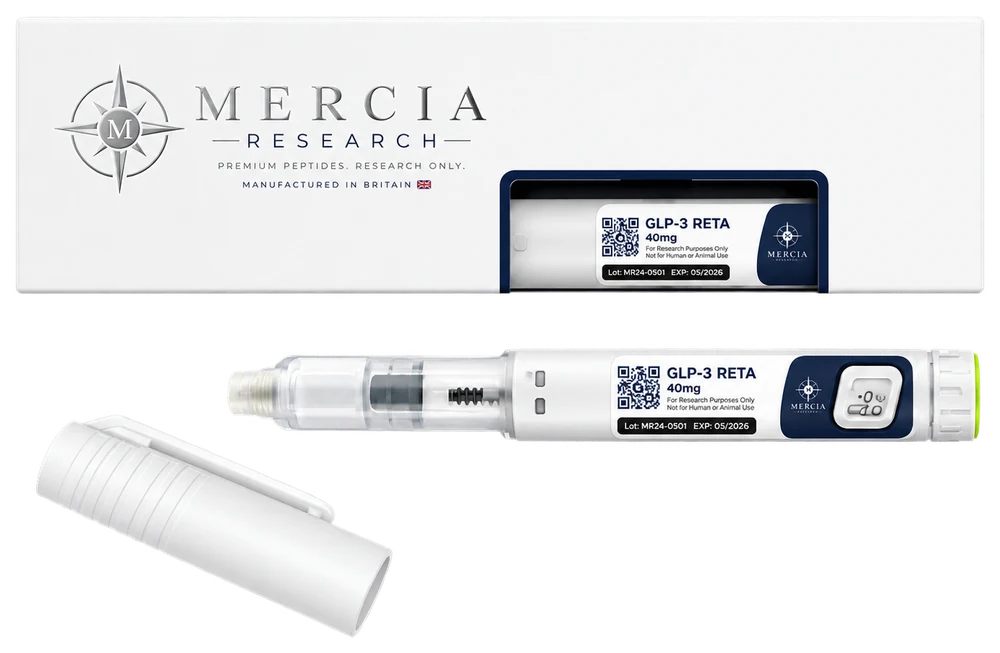
GLP-3 R
Investigational triple GLP-1/GIP/glucagon receptor agonist.
Purity
≥99.0%
Testing
HPLC
CoA
Every batch
Format
Pre-mixed
Amount per click
320 clicks in every pen · 3 ml cartridge
| Strength | 1 click | 10 clicks |
|---|---|---|
| 40 mg | 125 mcg0.125 mg | 1,250 mcg1.25 mg |
| 10 mg | 31.25 mcg0.03125 mg | 312.5 mcg0.3125 mg |
Each figure is the cartridge's total peptide content divided by the 320 clicks in the pen.
UK next-day delivery on orders placed Monday to Thursday, in validated temperature-controlled packaging.
GLP-3 R (development code LY3437943) is a 39-amino-acid, lipid-conjugated synthetic peptide, built on a GIP-receptor-derived backbone and modified to engage two further receptor targets simultaneously. It is currently an investigational compound, in Phase 3 clinical development (the TRIUMPH programme) and not approved for any indication by any regulatory body.
Triple Receptor Agonism
GLP-3 R's defining feature is simultaneous agonism at three distinct receptors: the glucose-dependent insulinotropic polypeptide receptor (GIPR), the glucagon-like peptide-1 receptor (GLP-1R), and the glucagon receptor (GCGR). This distinguishes it from semaglutide (GLP-1R only) and tirzepatide (GIPR/GLP-1R dual agonism), neither of which engage the glucagon receptor. Structural studies published in 2024 report that GLP-3 R is substantially more potent at GIPR relative to the native hormone, with comparatively attenuated (though still functionally significant) activity at GCGR and GLP-1R, a balance researchers attribute to its rationally engineered sequence.
The Glucagon Component
The glucagon receptor arm is the primary mechanistic differentiator from dual GIP/GLP-1 agonists. Research in animal models has reported that GCGR activation increases energy expenditure and hepatic fat oxidation directly, independent of the appetite-suppressing effects mediated by GLP-1R and GIPR. This "two-sided" mechanism, reduced intake alongside increased expenditure, has been proposed as the basis for GLP-3 R's larger effect sizes observed in trials to date compared with dual-agonist compounds.
Clinical Trial Findings
A Phase 2 randomised controlled trial published in the New England Journal of Medicine (2023, n=338, 48 weeks) reported mean weight loss of 24.2% at the 12mg weekly dose, compared with 2.1% in the placebo group, among the largest effect sizes reported in a peptide obesity trial to date. A separate Phase 2 trial in type 2 diabetes, published in The Lancet, reported significant improvements in glycaemic control alongside weight reduction. Ongoing Phase 3 TRIUMPH trials are evaluating GLP-3 R across obesity, type 2 diabetes, metabolic dysfunction-associated steatohepatitis (MASH), and obstructive sleep apnoea.
Research Format and Quality Assurance
Supplied as a pre-mixed liquid peptide solution with no reconstitution step, each cartridge is independently HPLC-tested for purity and confirmed for identity by mass spectrometry, with a lot-matched Certificate of Analysis issued for every order.
GLP-3 R is an investigational compound, not approved for any indication. For laboratory research use only. Not intended for human or animal consumption.